.
.
.
INSTITUTIONAL FRAMEWORK PORTFOLIO
Selected HSD Frameworks, Status & Indicative Impact Potential™
From Public Expenditure to Potential Measurable Public Value
Habib Sustainable Development (Pvt.) Ltd. (HSD), an Independent ESG Advisory & Value Assurance Institution, has developed a portfolio of institutional frameworks designed to strengthen governance, procurement value, public investment efficiency, financial-sector effectiveness and protection of public resources.
The following selected frameworks represent HSD’s current institutional work and their indicative potential impact. The figures are illustrative estimates intended to communicate the potential scale of value opportunity; they are not claims of guaranteed savings or realised financial benefits.
FRAMEWORK 01
Value-for-Money Transformation
Lowest-Bid to Value-Based Lifecycle Bidding Framework
Present Status: Submitted to PPRA through CAP and presently in implementation phase with the Government of Pakistan.
Governance Purpose: Strengthen procurement evaluation through lifecycle value, quality, performance, risk and total cost rather than initial price alone.
PKR 1.96 trillion/year*
FRAMEWORK 02
Value-Based Lifecycle Bidding System Framework
Present Status: Pilot Implementation Offer submitted to PPRA.
Governance Purpose: Provide a structured basis for value-based procurement decision-making and lifecycle assessment.
Subject to technical validation*
FRAMEWORK 03
Public Investment Value Assurance Framework™ (PIVAF)
Status: Submitted to PPRA.
Purpose: Support resource efficiency, cost optimisation and lifecycle value protection in public investment.
PKR 918 billion/year*
FRAMEWORK 04
Financial Sector Reform & Value Assurance Framework™
Status: Submitted to PPRA.
Purpose: Identify potential avoidable expenditure, process inefficiency, resource wastage and control gaps while protecting institutional effectiveness and service quality.
PKR 1.204 trillion/year*
FRAMEWORK 05
Institutional Segregation of Technical Verification & Payment Governance Framework™
Status: Submitted to PPRA.
Purpose: Strengthen public-money protection through appropriate separation of technical verification and payment-governance functions.
PKR 500–800 billion/year*
Basis of the Illustrative Impact Figures
*The illustrative impact figures are appended and supported by HSD’s underlying assessment assumptions, indicative calculations, sectoral expenditure bases, identified value-leakage/efficiency opportunities and framework-specific impact methodologies. They are presented solely as potential value opportunities for technical and institutional consideration and should not be interpreted as audited savings, approved government figures, or guaranteed financial outcomes.
Actual impact, if any, would depend upon technical validation, baseline data, institutional adoption, implementation scope, procurement and expenditure volumes, policy decisions, governance arrangements and independently verifiable results.
HSD’s Value Assurance Principle
Evaluate → Assess → Advise → Verify → Report
HSD’s objective is not merely to identify expenditure, but to help institutions determine whether public resources can generate greater value, stronger accountability, improved lifecycle performance and measurable public benefit.
Important: HSD does not handle public funds, appoint contractors, make payments or replace the statutory authority of government institutions. Its role is independent advisory, technical, governance and value-assurance support.
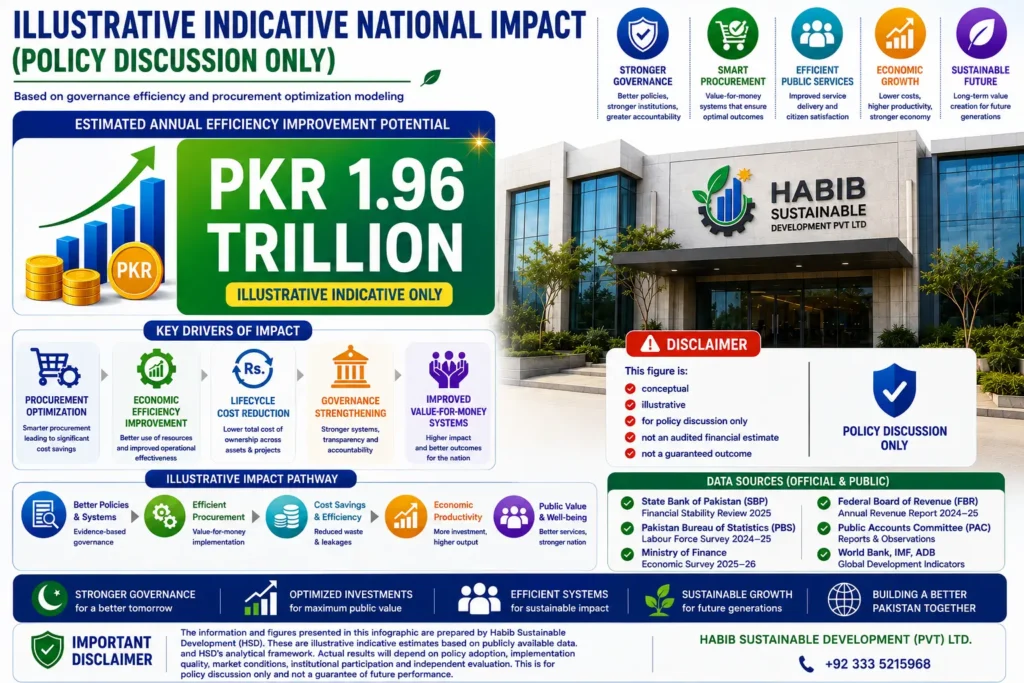
Transformation from Lowest Bidding system to value based System
Estimated Efficiency improvement potential which is 1.96 Trillion Annually Developed by Habib Sustainable Development (HSD) and Submitted to CAP and Now formally presented to the Government of Pakistan.
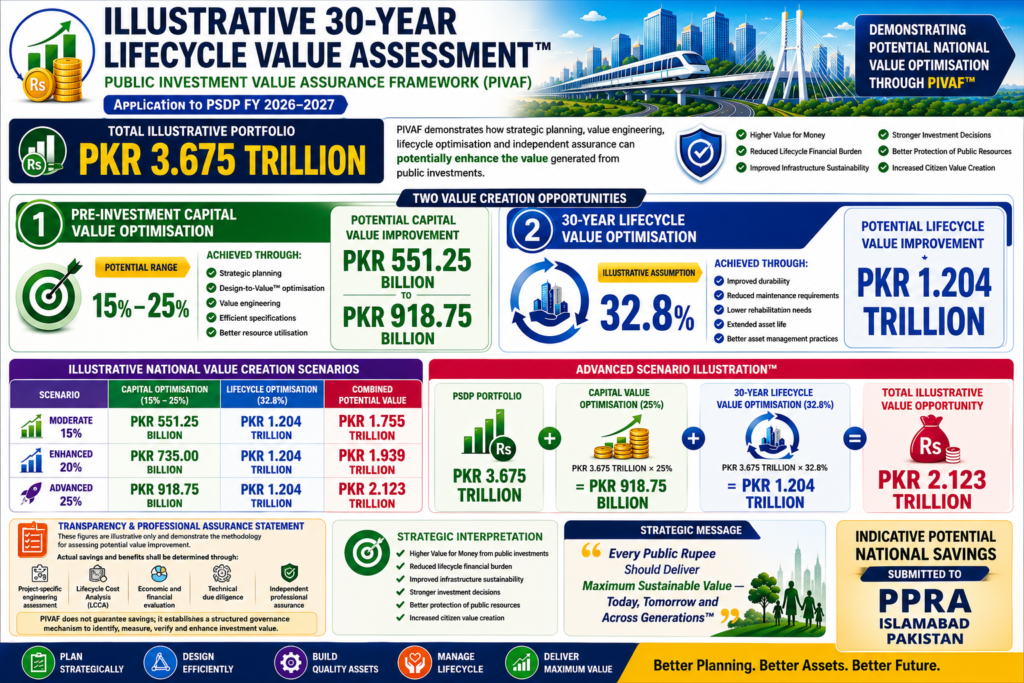
Public investment Value Assurance Framework (PIVAF)
Developed by Habib Sustainable Development (HSD) and Submitted to PPRA Islamabad Pakistan
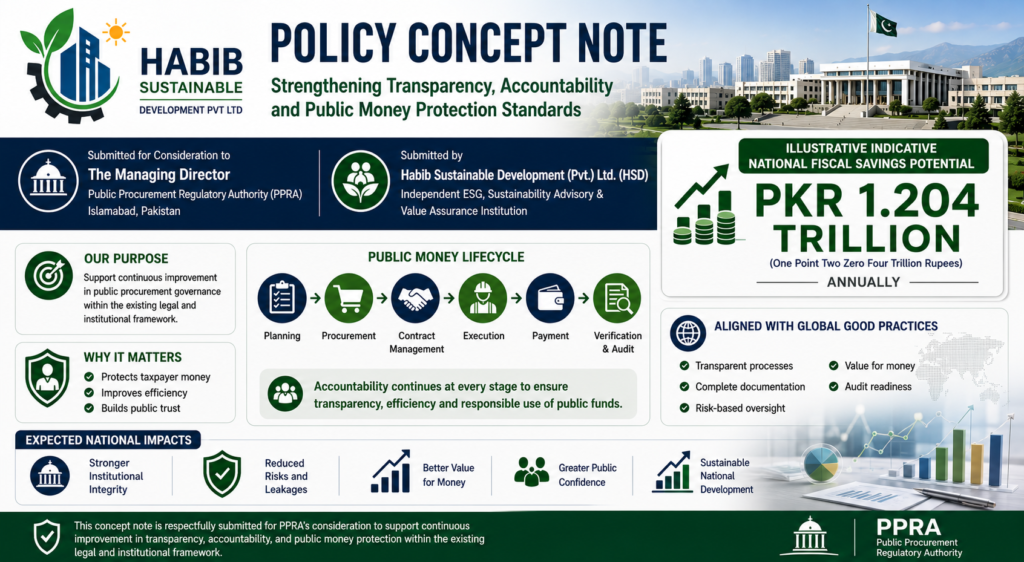
illustrative indicative national Fiscal savings potential Strengthening Transparency, Accountability and Public Money Protection Standards
submitted by
Habib Sustainable Development (HSD) PVT Ltd
to
the PPRA Islamabad Pakistan
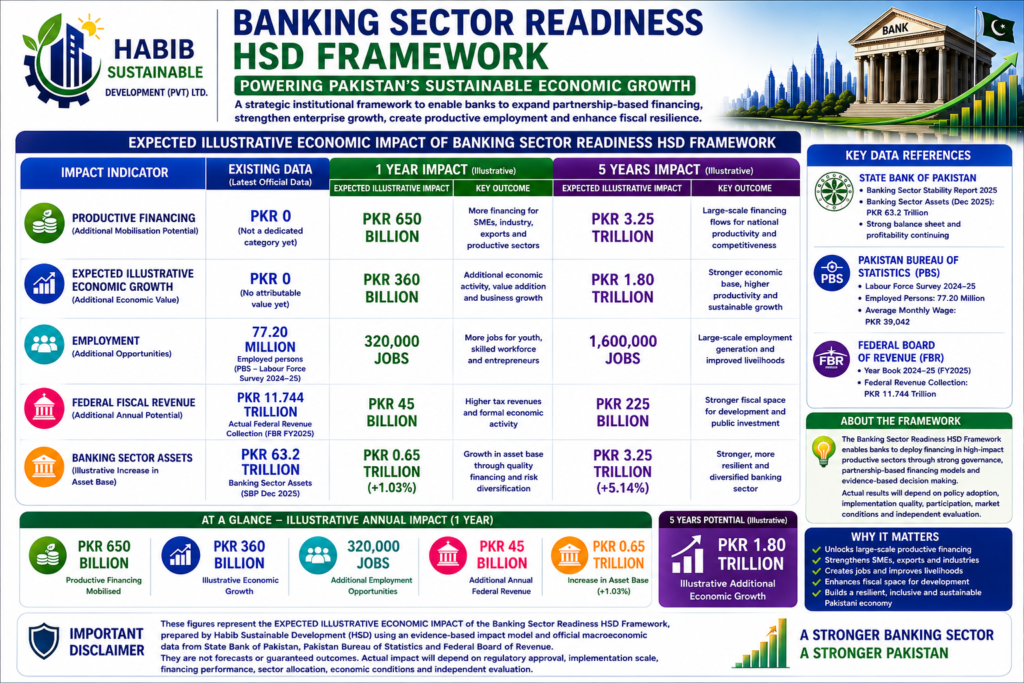
Banking Sector Readiness HSD Framework (BSRF™)
Preparing Pakistan’s Banking Sector for Sustainable Economic Growth & Employment Generation
The Banking Sector Readiness Framework (BSRF™), developed by Habib Sustainable Development (HSD), is a strategic institutional framework designed to strengthen Pakistan’s banking sector for the responsible expansion of partnership-based financing alongside existing financing mechanisms.
The Framework enhances institutional governance, regulatory readiness, digital transformation, enterprise preparedness, capacity building and value assurance, enabling banks to support sustainable business growth while maintaining financial stability and public confidence.
Expected National Impact
- Sustainable enterprise growth
- SME development and resilience
- Entrepreneurship and innovation
- Financial inclusion
- Export competitiveness
- Productive employment generation
- Long-term economic growth
BSRF™ provides a practical roadmap for building a stronger, more competitive and future-ready banking sector that contributes to Pakistan’s sustainable economic transformation.
Who We Serve
Advisory Services That Strengthen Institutions
HSD partners with:
Government Ministries
Public Sector Organizations
Regulatory Authorities
Development Agencies
International Donors
Financial Institutions
Commercial Banks
Development Finance Institutions
Corporate Organizations
Infrastructure Developers
Educational Institutions
Healthcare Organizations
NGOs & Civil Society Organizations

Governance
Governance & Economic Advisory
Improve public sector performance through economic efficiency analysis, stronger governance systems and optimized resource allocation.

Procurement
Value-for-Money Procurement Advisory
Improve public sector performance through economic efficiency analysis, stronger governance systems and optimized resource allocation.

Sustainability
ESG & UN SDG Integration
Improve public sector performance through economic efficiency analysis, stronger governance systems and optimized resource allocation.

Sustainability
Infrastructure Lifecycle Advisory
Strengthen infrastructure performance through lifecycle cost optimization, durability assessment, maintenance planning and long-term asset value improvement.